When a Headlamp Becomes Your Smart Outdoor Partner for Lighting and Adventure

Do you still remember the feeling of putting on a headlamp in the dark for the first time? The world, once a blurred chaos, was instantly sliced open by a clear beam of light. It used to be a simple tool, with the sole requirement of being “bright.”
But at some point, we began to have higher expectations for this beam atop our heads. We are no longer satisfied with it merely illuminating the three meters in front of our feet; we hope that in the campsite, it can provide a gentle, non-glaring glow; that when our hands are covered in mud or holding a fishing rod, it can be awakened with a simple gesture; and that during long cold nights, it can provide a lasting sense of security instead of extinguishing halfway.
Today’s headlamps are quietly evolving from passive lighting tools into “smart partners” that understand your needs and blend into your rhythm. This upgrade illuminates not just the path ahead but the entire dimension of the outdoor experience.
The Wisdom of a Beam: From “Manual Switches” to “Heart-to-Heart Connection”
The starting point of intelligence often stems from an insight into inconvenience. Traditional headlamps require you to accurately find and press a switch with your fingers—which is no small challenge when wearing gloves, having oil on your hands, or while climbing and carrying items.
“Modern smart headlamps bring the first revolution: a hands-free interaction method.”
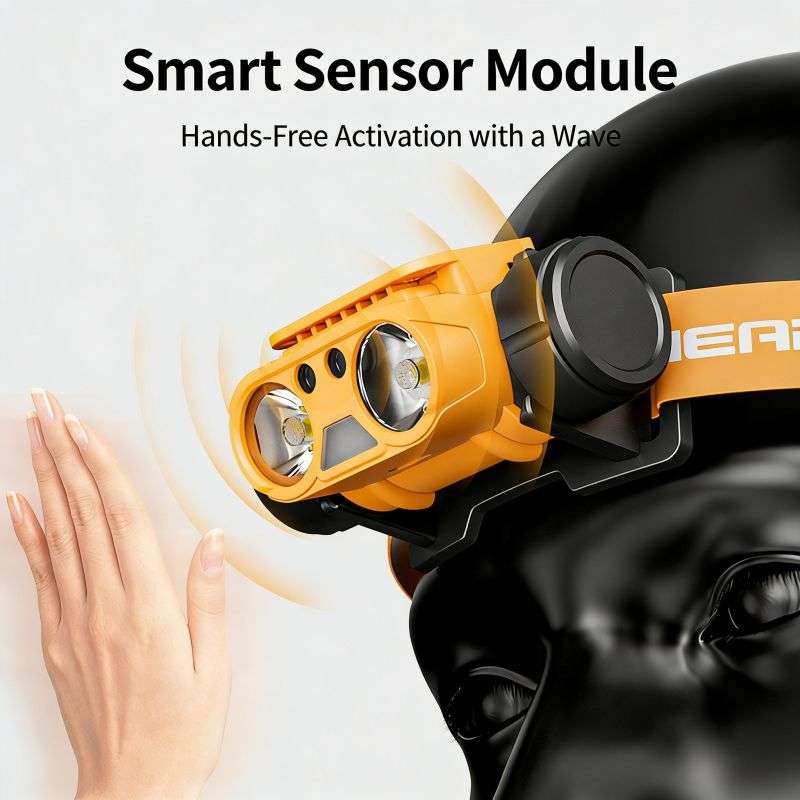
Imagine you are organizing a sleeping bag in a tent or handling a catch by the water; with just a gentle wave in front of your forehead, the light responds to your gesture. This control method, based on infrared or motion sensors, is not a gimmick; it truly solves a high-frequency pain point in outdoor activities, allowing light to truly “come when called and go with a wave.”
This outdoor headlamp with motion-sensing capabilities is the embodiment of this philosophy. It ensures you don’t have to fumble for buttons in moments when you need light most, especially when your hands are busy with other tasks. A simple waving motion can switch the light on/off or change modes. This seamless experience makes lighting more fluid and intuitive than ever before.
More Than Just White: A Dialogue Between Color Temperature and Scenarios
True partners know how to “speak according to the occasion,” and smart headlamps are the same regarding light language. While a single cold white light is bright, it may not be friendly in different scenarios: on a foggy morning, it will be heavily scattered, forming a vast white curtain of light; when resting at a campsite, it is too stark to create a relaxing atmosphere.
Therefore, advanced intelligence is reflected in the refined management of light color and patterns. Some headlamps have begun to integrate multi-color temperature LED light sources:
- Warm Yellow Light (approx. 3000K): Possesses stronger penetrating power in rain, snow, and fog, and makes the campsite atmosphere warm.
- Neutral White Light (approx. 5000K): Closer to natural daylight, suitable for general hiking and tasks.
- Cool White Light (High Color Temp): Appears conspicuous, usable for signals or special warnings.
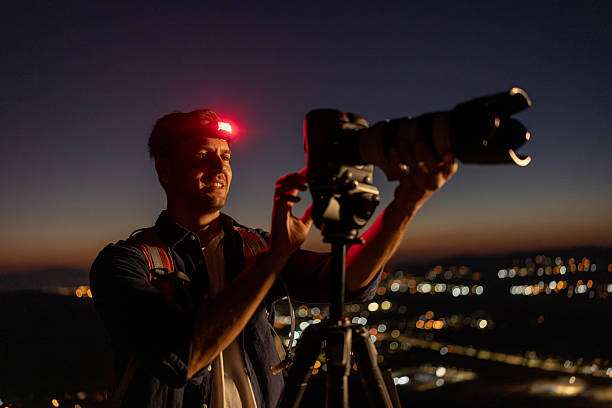
Going a step further is the independent red light mode. Red light is not only extremely power-efficient, providing dozens or even hundreds of hours of battery life as an emergency backup, but its greatest significance lies in protecting night vision. When checking maps or organizing gear in the pitch black, turning on the red light won’t cause pupils to shrink drastically; when you look back at the dark environment, your eyes adapt quickly.
Meanwhile, a flashing red light is the international SOS signal, a vital guarantee for outdoor safety.
Lasting Companionship: “Double Insurance” for Battery Life and Power Supply
For outdoor gear, “reliability” is a more important quality than “power.” The most direct manifestation of reliability is battery life.
Smart headlamps not only pursue long-duration battery life for a single charge—for instance, achieving over 10 hours or even dozens of hours in certain modes through efficient circuits—but also demonstrate “wisdom” in power strategies.
|
Power Feature |
Benefit & Application |
|---|---|
|
USB-C Direct Charge |
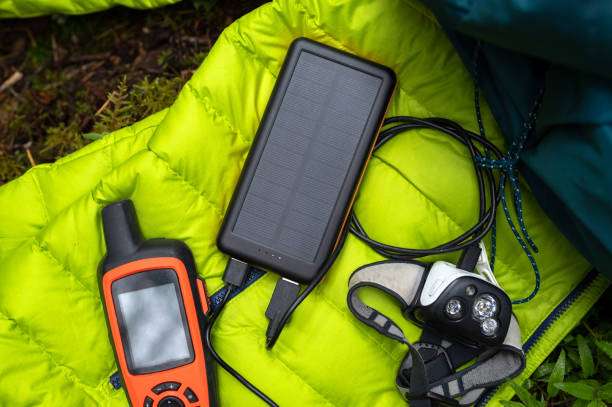
Use power banks or solar panels to eliminate battery anxiety. |
|
Dual Power Compatibility |
Supports both rechargeable lithium batteries and standard AAA batteries. |
|
Redundant Design |
Provides a crucial sense of security for long expeditions and extreme environments. |
This redundant design ensures that in extreme cases or when charging is impossible, you can still rely on emergency power.
Sensationless Guarding: Wearing Comfort and Rugged Protection
No matter how smart a partner is, if they become a burden, you won’t stay together for long. Therefore, top-tier designs pour intelligence into “making the user forget its existence.”
Extreme lightweighting is the foundation. By optimizing materials, the total weight is controlled within 100 grams, or even just 40-50 grams, making it almost unfelt. But more important than lightness are stability and comfort. A wide, breathable headband with internal non-slip strips ensures the headlamp doesn’t shake or slide during running or tilting. Ergonomic brackets distribute pressure, avoiding marks from long-term wear.
All this intelligence and comfort require a sturdy “body” to protect them. This leads to the IP Rating. High-level protection (such as IP66 or IP68) means the lamp body is precision-sealed to resist heavy rain, dust, and even short-term immersion.
When you don’t have to worry about weather changes and can fully trust your gear, you can truly focus on enjoying the exploration itself.
Frequently Asked Questions (FAQ)
Q: Are smart headlamps (like those with gesture control) prone to false triggers in complex environments? Like a branch brushing the forehead?
A: Mature products fully consider this. First, gesture sensing usually has a specific zone and distance (e.g., within 10 cm) and is not sensitive to just any movement. Second, many headlamps allow you to manually disable the sensor and switch back to physical buttons to adapt to specific scenarios like jungle trekking.
Good design provides convenience while returning final control to the user.
Q: Do I need to sacrifice brightness or battery life for these smart features?
A: Not necessarily. The core of smart features is more efficient energy management and more humanized interaction, not just power consumption. Low-power chips consume very little.
More importantly, features like smart dimming and multi-level choices allow you to actively select energy-saving modes when high brightness isn’t needed, extending the effective battery life. A well-designed smart headlamp can maintain powerful core performance while offering rich features.
Conclusion: Illuminating the Next Exciting Journey
So, it is time to re-examine that beam of light atop your head. It should not just be a tool used by force in the dark; it can be a smart partner that enhances your entire outdoor experience.
It understands your gestures, provides the most suitable light for the current environment, guards your sense of security with lasting battery life, and accompanies you through long nights with unfelt comfort.
“Upgrading a headlamp is, in essence, upgrading the way you interact with the night and the outdoors.”
When you are no longer distracted by operation, battery, and weather, you can become more immersed in the starlight, the sound of the wind, and the distance.
Before your next departure, why not choose a “Light Partner” who understands you better, letting it illuminate the road beneath your feet while also lighting up more fun and possibilities of exploration?