How a Headlamp Works: LED, Battery & Motion Sensor Tech Explained

Let’s play a quick game. Think about the last time you used a headlamp. You probably pressed a switch, got light, and went about your business. It feels simple, almost mundane. But have you ever stopped to wonder how that little device on your forehead manages to cast a beam hundreds of meters, run for hours, and survive a downpour, all while weighing less than a banana?
We live in an age of technological magic we take for granted. We tap screens, stream movies, and yes, turn on powerful lights with a click, rarely considering the engineering marvels in our hands or on our heads. Understanding the core tech behind a modern headlamp doesn’t just satisfy curiosity—it makes you a smarter buyer and a more confident user. It’s the difference between picking a light because it says “bright” and choosing one because you understand why it’s the best headlamp for your specific darkness.
So, let’s pop the hood and illuminate the clever principles that make your hands-free companion tick.
The Heart of the Sun: It’s All About the LED
Forget the dim, yellow, battery-guzzling bulbs of old camping flashlights. The single biggest revolution in portable lighting is the humble LED (Light Emitting Diode). Every modern, good headlamp is built around this technology.
How it Works: Unlike an incandescent bulb that heats a filament until it glows, wasting huge amounts of energy as heat, an LED produces light through electroluminescence. In simple terms, when electrical current passes through a semiconductor material, it excites electrons, which then release energy in the form of photons—light! This process is incredibly efficient, converting most of the energy into visible light with minimal heat.
Why It Matters for You:
- Efficiency & Battery Life: This efficiency is why a tiny LED headlamp can outshine old bulky lights and run for 10, 12, or even 15 hours on a single charge. The Ultra Lightweight Running Headlamp, for example, pairs a powerful 8W LED with a large 2600mAh battery. That efficient LED tech is what translates that battery capacity into a practical, worry-free 10-hour runtime for your longest jogging sessions.
- Durability: LEDs are solid-state devices with no fragile filaments to break from impact. They can handle the bumps and drops of hiking, work, or a tumble from your nightstand.
- Instant On & Control: LEDs reach full brightness instantly and can be dimmed or pulsed with precise electronic control, enabling the multiple modes (high, low, strobe, and red) that make a headlamp versatile.
Power Play: The Rechargeable Battery Ecosystem
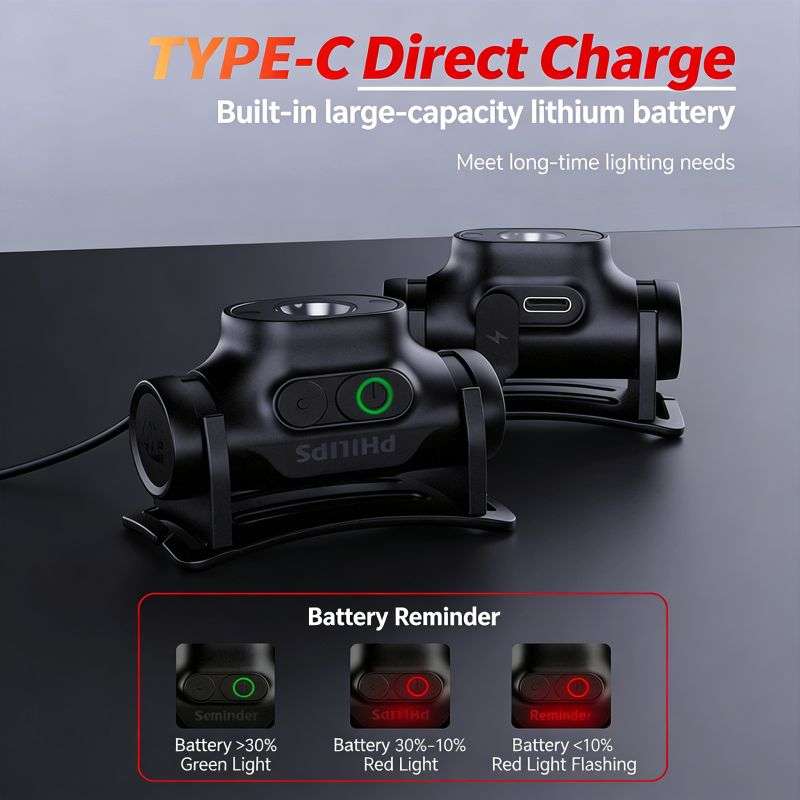
The LED is the star, but it needs a reliable, powerful understudy: the battery. The shift from disposable to rechargeable power is the second pillar of the modern headlamp.
The Chemistry: Most modern rechargeable headlamps use lithium-ion (Li-ion) or lithium polymer (Li-Po) batteries. They’re favored for their high energy density (lots of power in a small, light package), lack of memory effect, and relatively slow self-discharge.
Why It Matters for You:
- Cost & Convenience: Never buying AAA batteries again is a small joy. Just plug in a USB cable. It’s cheaper and more sustainable.
- Runtime Consistency: A quality rechargeable battery provides consistent voltage for most of its discharge cycle, meaning your headlamp stays brightest until near the end, rather than slowly dimming.
- Integrated Design: Built-in rechargeable batteries allow for slimmer, more waterproof designs. Look at the High Lumen Rechargeable Waterproof Headlamp. Its sealed, integrated system (500 mAh battery) is part of what makes its waterproof claim credible—there’s no battery compartment door that can leak.
Seeing the Light: Optics and Beam Shape
Here’s where engineering meets art. How do you turn the raw output of an LED into a usable beam? You need optics.
The Reflector vs. The TIR Lens:
- Reflector (Traditional): A mirrored bowl behind the LED catches its side light and reflects it forward. By carefully shaping this reflector, engineers can create a beam pattern, often with a bright central hotspot for throw and a softer surrounding spill for peripheral light.
- TIR (Total Internal Reflection) Lens: This is a clear plastic optic placed over the LED. It’s designed to capture nearly all the light and shape it into a very specific, controlled beam with a sharp cutoff and even distribution. TIR optics are often more efficient and can create a perfect wide flood beam ideal for camping or close work.
Why It Matters for You: This is the difference between a “wall of light” and a “laser pointer.” A headlamp designed for running, like the Ultra Lightweight Running Headlamp, uses optics to create a wide, even beam that illuminates the path and your periphery without dark spots. A light for search or long-range patrol would use optics to focus that energy into a penetrating spotlight. The High Lumen Rechargeable model gives you the best of both worlds with multiple modes, using optics and likely multiple LEDs to switch between flood and spot.
The Smart Switch: From Buttons to Gestures
The interface—how you tell your headlamp what to do—has gotten clever. It’s not just a simple on/off switch anymore.
Mechanical Switches: The reliable classic. A physical button you press. Good ones are sealed against moisture. The challenge is cycling through modes without accidentally turning it off.
Electronic Switches: These use a momentary contact under a rubberized button. A microprocessor reads the presses (short press, long press, double-click) to cycle through modes. This allows for more complex functions without adding more physical buttons.
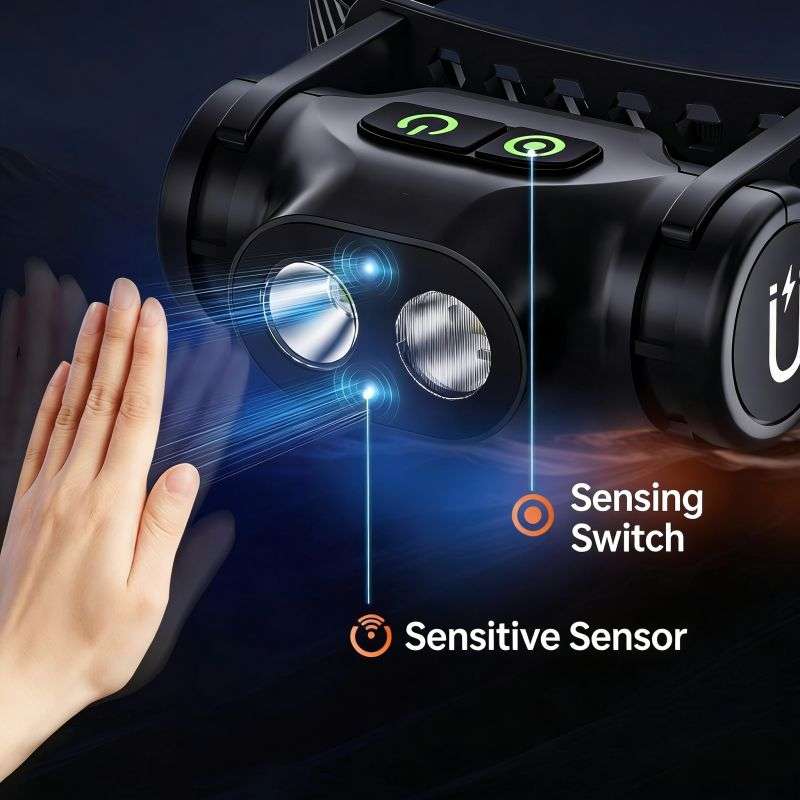
Motion Sensor Switches—The Game Changer: This is where we enter “smart” territory. An onboard infrared sensor detects movement in front of it. This isn’t magic; it’s a small, low-power sensor that triggers the main light.
Why the Motion Sensor Is Brilliant: Imagine your hands are covered in engine grease, soil, or fishing slime. The last thing you want to do is smudge your headlamp’s button. The Industrial LED Headlamp with Motion Sensor solves this elegantly. A casual wave turns it on or off. It’s the ultimate in hands-free operation. This feature isn’t just a gimmick; it’s a profound usability upgrade for work, maintenance, night fishing, or any task where your hands are occupied or dirty. The convenience-focused With a motion sensor and long battery life, the outdoor headlamp extends this smart logic to camping and hiking, letting you activate light when crawling into a tent or handling gear.
Built for the Real World: Materials and Environmental Sealing
A brilliant light is useless if it dies in the rain or cracks from a short drop. The unsexy but critical tech is in the housing.
Materials: ABS plastic is the workhorse—tough, impact-resistant, and lightweight. It’s used in our industrial and running headlamps for its great balance of strength and weight. PVC can offer enhanced flexibility and weather resistance, as seen in the High Lumen model’s durable, waterproof body.
Waterproofing (IP Ratings): You’ll see terms like “waterproof” or “water-resistant.” The real standard is the IP (Ingress Protection) code, like IPX4 (splash-resistant) or IPX7 (can be submerged in 1 meter of water for 30 minutes). A true waterproof headlamp for serious camping or cave exploration needs a high IP rating, achieved through sealed lens assemblies, rubber gaskets at the button, and covered ports. View more detailed information about the waterproof rating.
Thermal Management: Even efficient LEDs produce some heat. Well-designed headlamps use the housing as a heat sink to dissipate this warmth, ensuring the LED maintains performance and longevity over long periods on the brightest setting.
Putting It All Together: A Symphony in a Small Package

When you click the switch on a modern headlamp, here’s what happens:
- You complete a circuit from the rechargeable battery.
- A microprocessor wakes up and interprets your button press or motion sensor signal.
- It regulates the precise amount of power sent from the battery to the LED chip.
- The LED emits light, which is immediately collected and shaped by a precision reflector or TIR lens.
- This shaped beam exits through an impact-resistant lens, protected by a housing that manages heat and seals out the elements.
This entire symphony of physics, electrical engineering, and material science happens in a snap, inside a device that fits in your palm.
Knowledge is Power and Light
Understanding this tech demystifies your gear. It explains why you should look for a rechargeable LED headlamp with a thoughtful beam pattern. It highlights why a feature like a motion sensor isn’t just cool but contextually brilliant for specific tasks. It helps you see past marketing terms to the real-world engineering that enables a safe night riding trip, a productive hunting setup at dawn, or a simple repair in your own basement.
Your headlamp is more than a simple tool. It’s a compact showcase of human ingenuity designed to push back the night. Ready to experience intelligent headlamp technology designed for real-world use? Explore headlamps where smart technology meets practical, hands-free design for any adventure.