
It was just after 2 a.m. when I stood in my driveway, a bolt in my teeth, wrestling a bike rack one-handed while my phone’s weak flashlight flickered uselessly. My neighbor walked by with his dog, paused, and said, half amused, half wise, “You know, they make lights you wear on your head.” We laughed. A week later, he saw me finishing a late-night garden cleanup, a steady beam lighting my work. He nodded. That quiet shift—from shared humor to shared understanding—made me wonder: we talk about screens disconnecting us, but what about the simple tools that quietly do the opposite?
Beyond its practical beam, a headlamp can be a surprisingly social object. It doesn’t just illuminate the path; it can signal presence, foster cooperation, and carve out pockets of shared experience in the encroaching dark. This isn’t about the specs; it’s about the subtle, often overlooked role a simple hands-free light plays in how we interact.
The Signal in the Dark: More Than Just a Beacon
Think of the last time you saw a bobbing light on a distant trail at dusk or a steady beam in a neighbor’s garage. That light is a non-verbal communication. It says, “I am here. I am active.” In a world where we’re often isolated in our well-lit boxes, a headlamp visibly projects engagement with the physical world.
For the night running enthusiast, that moving light is a signal to drivers and a point of recognition for fellow runners. It creates a silent, fleeting community of people choosing to move under the stars. For someone on patrol or a night fishing dock, it’s a mark of responsibility and presence. The light itself becomes an identity, a badge of purpose in the darkness. It transforms the wearer from an invisible shadow into a recognized actor in the shared nightscape.
The End of “Can You Hold the Light?” Relationship Test
Let’s name the universal, low-grade relationship friction: being drafted as a human flashlight stand. Whether it’s your partner fixing the sink or your kid looking for a lost toy under the couch, the dynamic is fraught. The holder gets bored, their arm tires, and the beam drifts. The doer gets frustrated, squinting in the inconsistent light. “A little to the left! No, my left!”
A headlamp dissolves this tension instantly. It’s a tool of relational harmony. By equipping the person doing the task with direct, head-mounted light, you liberate the helper to actually help—or to simply not be needed, which is sometimes the greater gift. It turns potentially frustrating collaborative work into efficient, self-sufficient action. This is especially true in family settings during power outages or camping trips, where a headlamp can turn a scary, chaotic moment into an adventure where everyone has their own sphere of controlled light.
Shared Light, Shared Focus: Creating Mini-Communities

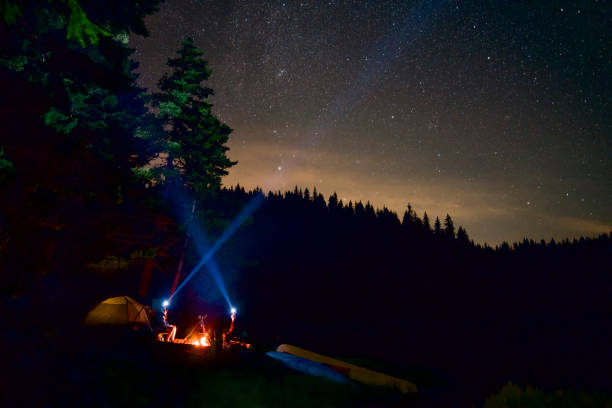
There’s a particular magic to a headlamp used in a group setting. Around a camping site after sunset, individual headlamps create a dance of intersecting beams. People cook, set up tents, or map-read, each in their own pool of light, yet connected by the soft glow and occasional shared glance. It’s the opposite of sitting around a single blinding lantern; it’s communal yet personal.
This extends to search parties, volunteer cleanups that run past dusk, or even a group of friends tackling a car repair. The shared use of the tool creates an unspoken bond of purpose. You’re not just people in the dark; you’re a team equipped for the conditions. The headlamp becomes a uniform of sorts, signifying membership in a temporary, task-oriented community.
The Unintended Consequence of Hands-Free Light: Presence
This is the most subtle effect. When your light is strapped to your head, your hands are free. This means you can make eye contact. You can gesture. You can hold a child’s hand while walking a dark path. You can give a full hug to a friend you’re picking up from a late arrival without first having to drop or awkwardly maneuver a flashlight.
The technology of a headlamp—the very fact that it’s wearable—prioritizes human interaction. It removes the literal barrier of a handheld object that demands your grip and attention. Your focus can be entirely on the person, the task, or the environment, not on managing the source of illumination. In an age of digital distractions, the headlamp is an analog tool that forces a kind of attentive presence. You are in the dark, dealing with it directly, and your body language remains open and available.
The Modern Artifact: When Smart Design Meets Social Grace
The evolution of the headlamp itself reflects a desire for more graceful interaction. Take the motion-sensor feature. On the surface, it’s a technical convenience. But socially, it’s a small masterpiece of consideration.
Imagine you’re camping, your hands full with a steaming pot. Instead of asking someone to hit the switch on your headlamp or doing an awkward chin press, you simply wave. The light comes on. The flow of the moment—the conversation, the shared meal preparation—isn’t interrupted. Or picture a mechanic mid-maintenance, covered in grime, who can activate his light without smudging it. It preserves the cleanliness of the tool and the continuity of his work. This isn’t just gadgetry; it’s social ergonomics. It’s a design that understands we are often with others, our hands are often full, and the smallest friction points can disrupt connection and flow.

I see this thoughtful design in something like the With Motion Sensor and Long Battery Life Outdoor Headlamp. Its core promise isn’t just about raw power; it’s about “staying hands-free on your outdoor adventures.” That long battery life (up to 15 hours) means you won’t be the person whose light dies mid-task, forcing the group to stop or reshuffle resources. The sensor means you interact with your environment and companions, not just with a button. It’s built for extended, seamless engagement—the kind that fosters shared experiences rather than focusing on managing the tool itself.
A Counter-Cultural Glow
In a culture that often equips us for solo, screen-based consumption, the headlamp is a tool for tangible, often shared, production. It enables us to build, fix, explore, and care for things and people outside in the real world, beyond the glow of business hours. It reclaims the night not for isolation, but for a different kind of activity—one that often requires or benefits from others.
That nod from my neighbor said it all. It acknowledged a shared move away from frustration and toward capability. My headlamp was no longer just my light; it had become a small signal in our little ecosystem, a sign that someone was engaged, self-sufficient, and present in the shared, darkening world. And sometimes, the most meaningful connections are woven from those quiet, well-lit threads of understood competence.
Experience the seamless, socially aware design of a motion-sensor headlamp for yourself.