5 Essential Headlamp Tips for Stress-Free Nighttime Car Repairs

Imagine this scenario: night falls, and your car suddenly acts up in the garage or on the roadside. Perhaps it’s a strange noise, or maybe a warning light turns on, and you have to address it immediately.
You pull out a flashlight, clenching it between your teeth or under your shoulder, trying to locate that stubborn bolt in the dim light. Your hands are covered in grease, and your own shadow blocks your view—anxiety and helplessness instantly resonate with anyone who has done DIY car repairs.
In reality, what you’re missing isn’t technique or tools, but a smart, hands-free source of light. Today, we’ll explore how one seriously underrated tool—a headlamp—can completely transform your car repair experience.
This isn’t just illumination; it’s the key step from chaotic fumbling to calm efficiency.
Pain Points Revisited: When Darkness Becomes Your Biggest Obstacle

Before diving into the tips, let’s acknowledge the moments that make nighttime car repair so frustrating:
- Changing a spare tire: Once the jack is in place, the bolts are often hidden in shadows. A regular flashlight either scatters light or requires a third hand to hold it.
- Checking the engine bay: Complex hoses and wires are hard to reach, and adjusting a handheld light repeatedly is exhausting.
- Reading vehicle manuals or repair guides: Extra lighting is needed to illuminate paper or screens, interrupting workflow.
- Working on the chassis or wheel wells: Lying or squatting makes handheld lighting awkward and unstable.
All these moments call for a solution: a reliable headlamp that moves with your head and completely frees your hands.
5 “Light Tips” to Boost Repair Efficiency
Tip 1: Angle Is Everything—Precise Illumination, Goodbye Shadows
A good headlamp must have an adjustable head. Simple in theory, but crucial for repairs.
When checking the dipstick, tilt the beam 30° downward for precision. When lying under the car inspecting the exhaust, flip the lamp head 90° upward to illuminate the target area directly.
Precision lighting that follows your line of sight eliminates stubborn shadows from handheld sources, letting you see every detail clearly.
Key Point: Choose a headlamp with smooth, resistant angle adjustment that can be easily pushed or pulled with the back of your hand or wrist—even with gloves or greasy hands.
Tip 2: Beam Mode Switching—From Macro to Micro Tasks
Repair work isn’t uniform. You need two types of light:
- Flood: Provides a broad view of the engine bay or undercarriage, quickly spotting leaks, loose parts, or rust.
- Spot: For fine work like identifying part numbers, soldering small circuits, or inspecting threads deep inside holes.
Modern professional repair headlamps offer multi-mode switching.
Use flood to scan broadly, then switch to spot for precision. For example, locate the transmission oil pan with flood, then zoom in on the drain bolt with spot mode.
Tip 3: Hands-Free, Safety First—A Must-Have
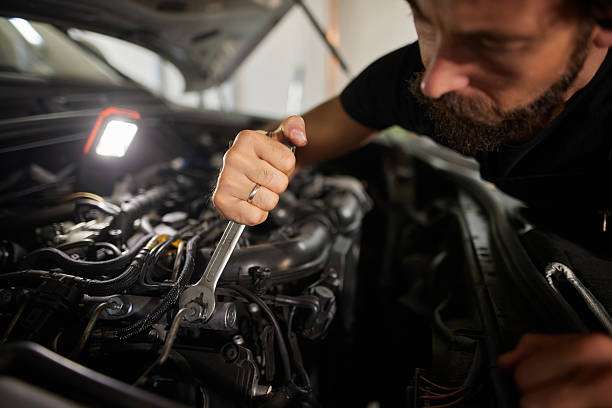
This is where a headlamp outshines any flashlight.
When tightening a cylinder head bolt to a specific torque, your hands must control the wrench steadily. Connecting tiny electrical connectors also demands full hand dexterity.
A headlamp completely frees your hands from lighting duties, letting you work safely and efficiently. Your hands should be 100% focused on what they do best.
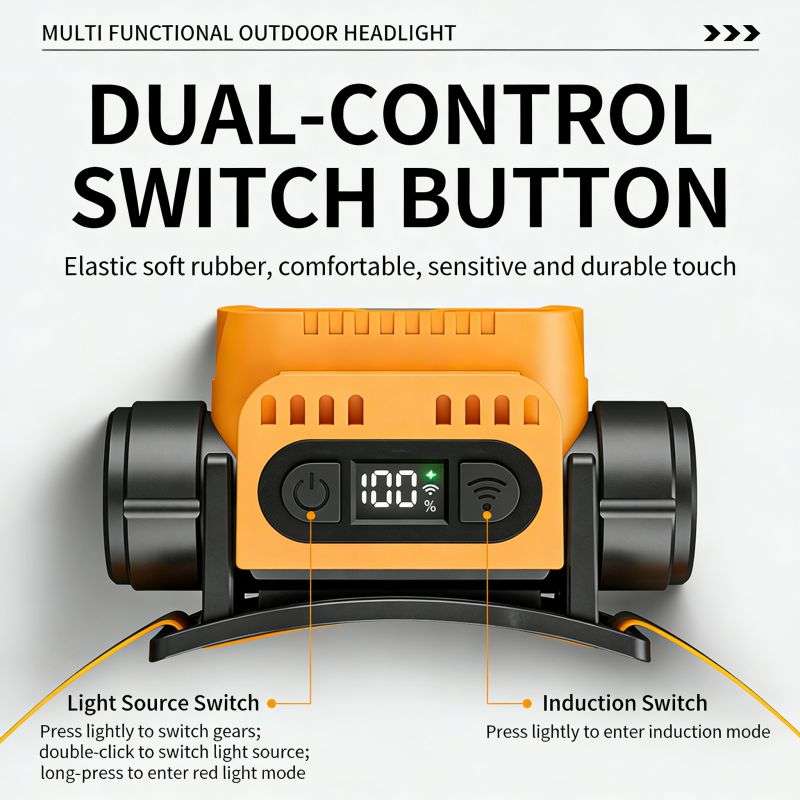
Tip 4: Sensor Function—A Lifesaver When Your Hands Are “Dirty”
This is true game-changing technology. Imagine finishing an oil filter replacement with hands covered in black oil or dealing with brakes with dust-covered hands. You don’t want to touch your beloved tools or the lamp switch.
Industrial-grade headlamps with sensor switches allow you to wave your hand to turn the light on/off. Need to check the manual? Wave. Need to change modes? Wave twice. It keeps equipment clean while letting you work elegantly and efficiently, even in messy situations.
Tip 5: Long Battery Life—The Confidence to Last Through a “Battle”
Nothing is more frustrating than a dimming light in the middle of repairs.
Complex tasks like timing belt replacement or electrical diagnostics can last several hours.
Long battery life is essential. Focus on actual runtime at medium brightness (the most common work setting), not the short bursts at maximum brightness.
Repairs lasting 3–4 hours require a headlamp that can reliably illuminate the entire session without recharging or swapping batteries, maintaining your immersive workflow.
[Discover the Best Hands-Free Headlamp for Repairs]
Product Compatibility: Lighting Partners Built for Tough Environments
Not all headlamps belong in your toolbox. Garages and roadside environments demand durability, intelligence, and reliability. An industrial LED headlamp designed for high-intensity work fits these scenarios perfectly:
- Sensor switch: Handles “dirty hands” effortlessly.
- Impact-resistant casing: Survives toolbox bumps or accidental drops.
- Adjustable head and anti-slip strap: Keeps light steady in awkward positions like lying or bending.
- Multi-level brightness: Switch from “micro-light” for fine observation to “broad flood” for overall scanning.
This combination of flexibility and durability distinguishes professional use from casual tasks.
FAQ
|
Question |
Answer |
|
Do automotive repair headlamps need extremely high brightness (lumens)? | No. At 1–2 meters, excessive brightness (especially in spot mode) causes glare on metal/plastic surfaces and impairs judgment. A quality 3W LED with good optics is sufficient for clear, even, glare-free illumination. The key is light quality, adjustability, and ease of operation, not just “highest numbers.” |
|
Is it safe to inspect high-temperature engine parts with a headlamp? |
Maintain safe distance and common sense. Headlamps are for ambient and work lighting only. Do not place directly on or expose hot components like exhaust manifolds or turbochargers. Always follow safe work practices and let the light illuminate the work, not test temperatures. |

It’s time to reevaluate your toolbox. Next time you tackle nighttime or garage repairs, before picking up a wrench, wear a reliable headlamp.
You’ll find it offers more than light. It brings calm, precision, and full control of your hands. Darkness transforms from an “obstacle” to a “background curtain” you can work against.
Start by illuminating that stubborn bolt and experience the true joy of focusing on the repair itself.