Spotlight vs. Floodlight: Choosing the Right Headlamp Beam for Any Adventure

Turning on your headlamp in the darkness only to find distant targets clear while the gravel at your feet is shrouded in shadows—or having a bright light right in front of you but failing to see trail markers ten meters away. These awkward lighting experiences usually stem not from insufficient brightness, but from choosing the wrong beam type.
For headlamps, lumen count (brightness) is often the focus, but what truly determines performance in specific scenarios is how the light is projected. Simply put, it depends on whether your headlamp uses a spotlight or a floodlight. Understanding the fundamental differences between these two beams allows the light in your hand to truly become an extension of your vision in the dark.
One Light, Two Missions: Spotlight vs. Floodlight
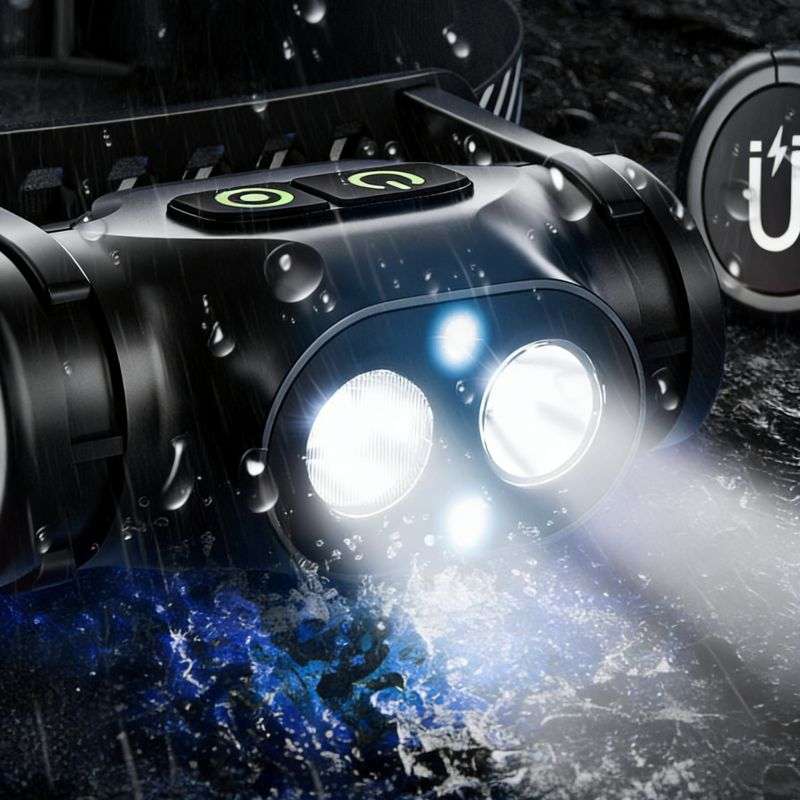
We can think of a headlamp’s beam as an extension of your gaze.
The Spotlight (Point-to-Point)
“Spotlight is like squinting your eyes to focus intently on a distant point.”
Its beam angle is narrow, the light is concentrated, and energy is gathered in one place for the purpose of seeing far. It can pierce the night to clearly illuminate distant road signs, ridgelines, or targets at the edge of your vision. This beam has a bright core spot and long throw distance, making it a sharp tool for exploration and long-range navigation.
The Floodlight (Area Coverage)
“Floodlight is like opening your eyes wide to effortlessly scan your surroundings.”
Its beam angle is broad, spreading light evenly across a wide area for the purpose of seeing wide. It provides comfortable, shadow-free illumination for the large area at your feet and in front of you, allowing you to see every rock on the ground and the overall environment while at camp, reading maps, repairing gear, or hiking. Floodlighting weakens the harsh center spot, reduces eye fatigue, and emphasizes environmental awareness.
Scenario Matching: When to Call Upon Which Light?
The choice of light depends entirely on what you are doing at the moment.
|
Activity Type |
Recommended Beam |
Primary Benefit |
|---|---|---|
|
Hiking & Climbing |
Spotlight |
Identifying junctions and terrain hazards from a distance. |
|
Search & Patrol |
Spotlight |
Unreplaceable long-range visibility for locating targets. |
|
Cave Exploration |
Spotlight |
Illuminating deep passages and distant cave walls. |
|
Camp Life |
Floodlight |
Setting up tents and cooking with a wide, even field of view. |
|
Close-quarter Tasks |
Floodlight |
Eliminating hand shadows during gear repair or DIY work. |
|
Night Jogging/Cycling |
Floodlight |
Perceiving road changes and surroundings for safety. |
By understanding these differences, you can avoid the inefficiency of using a spotlight to find keys or a floodlight to scout a distant trail.
The Smart Choice: Finding the Balance of “Dual-Beam”
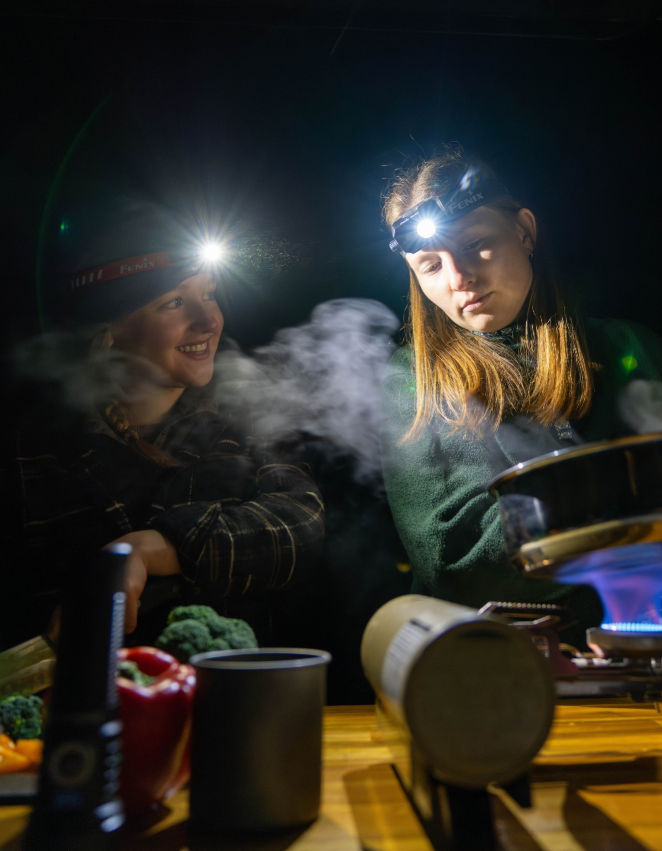
The ideal situation is not choosing one over the other, but switching or combining them based on need. Many modern high-quality headlamps offer “hybrid” solutions through two main designs:
- Dual-Source Systems: These headlamps feature independent spotlight and floodlight LEDs. You can turn them on separately or together to achieve both a long-range center beam and wide-area ground lighting.
- Variable Zoom Optical Systems: By physically adjusting the lens, you can transition smoothly between spotlight and floodlight, providing maximum flexibility for changing environments.
The key is that a well-designed headlamp makes you almost unaware of the technology; it makes light a natural instinct. For example, a headlamp designed for diverse outdoor environments excels because it offers multiple brightness settings and flexible beam control.
Whether you need a beam to probe the path on a rugged trail or a wash of light to create a cozy atmosphere at camp, you can find the most suitable mode through simple adjustments. Combined with long battery life and reliable waterproofing, it ensures this light stays stable whenever you need it, becoming a trusted partner in exploring the unknown.
[Explore Professional Dual-Beam Headlamps for Your Next Adventure]
When choosing a headlamp, besides focusing on brightness and battery life, ask yourself: “Is the beam pattern right for my primary activity?” The answer will determine whether your experience in the dark is restricted or effortless.
Frequently Asked Questions (FAQ)
Q: Is a headlamp with a stronger spotlight (long-range) always better?
A: Not necessarily; it depends on your use. For night hiking, search and rescue, or caving, a strong spotlight is vital. However, for camping, repairs, or daily jogging, an overly intense spotlight creates a narrow field of vision, makes the ground underfoot harder to see, and causes eye fatigue. Flood or hybrid beams are safer and more comfortable choices.
Q: How can I tell if a headlamp is spotlight-oriented or floodlight-oriented?
A: Look at keywords and the beam angle (in degrees). Terms like “Long-range,” “Focused,” or “Strong Center Spot” indicate a spotlight bias. “Wide-range,” “Flood,” or “Even Light” indicate a floodlight bias. A more direct way is to check beam pattern photos: if the center is small and bright with fast fall-off, it’s a spotlight; if the transition from center to edge is soft and covers a large area, it’s a floodlight.
Conclusion
Light is the alternative language of the outdoor night. Spotlight is the gaze and inquiry into the distance; floodlight is the embrace and care for one’s surroundings. A headlamp that understands and integrates these two languages is more than just a tool—it is an extension of your vision, a basis for judgment, and a guarantee of safety.
“Next time you prepare to click that switch, ask yourself: Do I need a sword to pierce the mist, or a candle to warm my surroundings? The answer lies in your choice of beam.”